









Safety is one of the most crucial factors to consider when making advancements in business. This is closely related to the legal and technical actions that have been taken, as well as worker protection. Every year, 2.3 million people suffer fatalities as a result of occupational illnesses and injuries at work, with Asia bearing the brunt of this burden due to the region’s massive industrial expansion. With these figures, it is clear that measures must be put in place to keep the economy running, the most significant of which is operational safety.
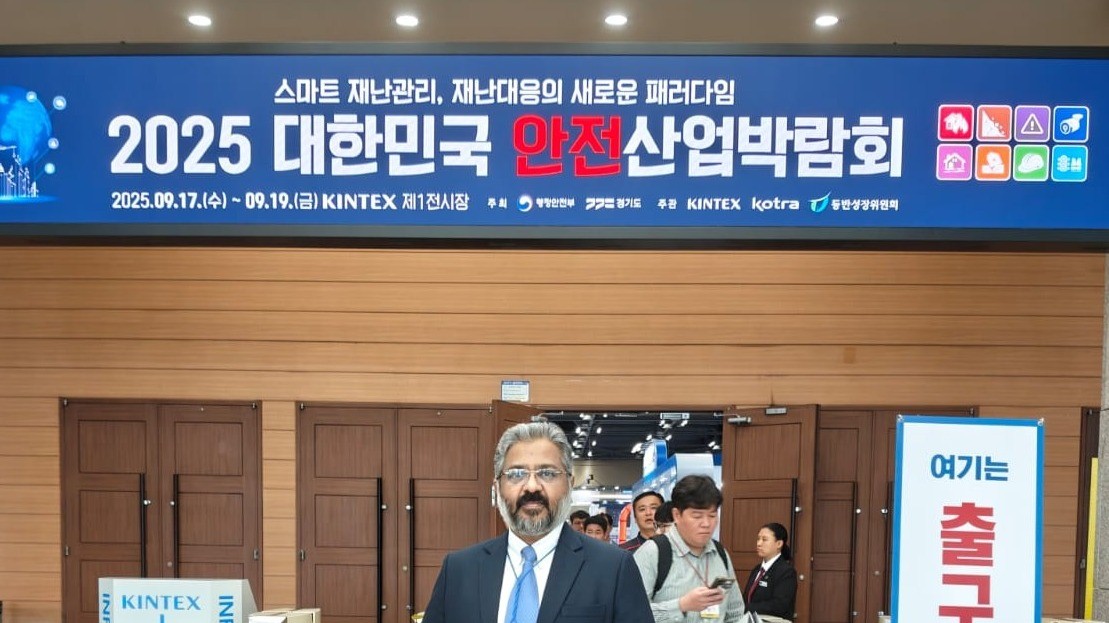
Seoul, while hosting the K-SAFETY EXPO 2025 between 17th and 19th September 2025, showcased the importance of operational safety. The exhibition was not just about heavy industrial tools; it turned into a hub where buyers, sellers, decision-makers, and innovative thinkers united to manage industry prediction risks. The level of interest and complexity of the solutions offered proved how core K-SAFETY EXPO 2025 has become in regard to safeguarding life and progress in the industry. A diverse range of industry leaders, up-and-coming businesses, regulators, and legislators were present at the expo, all of whom were showcasing their contributions to the development of industrial safety. As technology became the focal point, post-event reactions gave way to preventative actions. In order to predict such threats, artificial intelligence continuously monitored operational parameters.
Digital twin simulations provided engineers with accurate modelling skills to assess and optimise emergency responses, while robotics carried out inspections in hazardous places.Electric vehicle safety emerged as a focal point, reflecting global shifts in mobility. Lithium-ion battery hazards have challenged manufacturers and regulators worldwide. On the exhibition floor, advanced fire suppression systems demonstrated their ability to contain thermal runaway events. Equipment for safe storage, handling, and even recycling of EV batteries highlighted that safety extends beyond initial use into the entire lifecycle of new technologies. It became evident that nations willing to integrate such systems early will hold an advantage as transport and energy infrastructures transition.
Equally notable was the policy engagement. In discussions with government officials, including Yongdu Kim, Director of the Disaster and Safety Industry Division at Korea’s Ministry of the Interior and Safety, the message was unambiguous. Korea is prioritising systemic reforms through advanced disaster response zones, stricter corporate responsibility laws, and targeted incentives for safety innovation. This mirrors regional developments in Asia where India has consolidated workplace safety regulations through its Occupational Safety Code and Singapore has strengthened penalties for lapses in industrial safety. Regulation is evolving as both a deterrent against negligence and an enabler of innovation.
The scale of potential economic loss amplified the urgency of workplace safety initiatives. South Korea estimates annual losses of approximately 18 billion US dollars due to workplace accidents. India reported over 48,000 occupational accidents in a single year. Japan continues to invest heavily in predictive safety systems to secure its manufacturing backbone. Each case adds weight to the argument that safety is an economic strategy as much as a moral imperative. Unaddressed risks can slow industrial growth, erode competitiveness, and weaken public trust.The context is sharpened by comparisons with North America and Europe. With the European Agency for Safety and Health at Work spearheading directives among member states, Europe’s regulatory frameworks are extremely codified. Although this has led to high compliance, the adoption of innovations is frequently slowed down by onerous procedural frameworks. Market-driven models have created innovative technologies in North America, especially in the US, but inconsistent state laws can occasionally make uniform implementation difficult. In contrast, Asia is becoming a region of faster adoption, with governments and businesses integrating digital and predictive systems at a rapid pace.
The multinational makeup of attendees at K-SAFETY EXPO was another noteworthy feature. European, North American, and Middle Eastern delegations held a technical and strategic conversation with Asian stakeholders. The expo was organised with themed pavilions covering everything from public security and industrial risk reduction to fire safety and catastrophe management. While seminars established a learning environment where government representatives, researchers, and business executives shared best practices, export consulting sessions enabled Korean producers to investigate foreign markets. This showed that safety has become a shared global language with its own marketplace, policy frameworks, and knowledge networks. For me as a media representative, the event provided an abundance of knowledge and revealing experiences.
“The protection of human life in industrial settings requires more than policy and technology. It demands informed attention and public engagement, and media reporting serves as the conduit that amplifies safety lessons to a worldwide audience.”
Covering such an event means going beyond listing innovations or recording speeches. It is about translating complex systems into insights that engineers, managers, regulators, and even workers can act upon. Media becomes an instrument that connects breakthroughs to their intended users. It also carries a responsibility to verify claims, scrutinise applications, and question scalability. In doing so, reporting becomes part of the larger safety ecosystem by amplifying practices that reduce risks and by holding attention to areas where gaps remain.The tone of K-SAFETY EXPO 2025 was distinctly forward-looking. There was recognition that accidents once considered inevitable are now preventable with predictive analytics. Hazards once tolerated are now managed with automated interventions.
Equipment, once mechanical, is now integrated with digital intelligence. Conversations that once revolved around compliance have shifted toward resilience and competitiveness.Walking out of KINTEX after three days of coverage, the impression was of an industry and a region willing to set new benchmarks. Asia, with its scale, speed of industrialisation, and rising regulatory standards, is stepping into a leadership position. Europe and North America may have pioneered earlier frameworks, yet Asia is where the next generation of solutions will be tested and refined.Industrial safety has always been about protecting lives, but today it is also about protecting the future of industries themselves. The momentum perceived at K-SAFETY EXPO 2025 holds a larger lesson. When policymakers, innovators, and industries move in step, safety ceases to be a limitation and becomes an advantage.
For participants, the takeaway was unambiguous. As reactive safety closes its chapter, intelligent prevention emerges as the new axis of industrial safety. Are you ready to witness the future?


