








1st July, 2026, Pune
Few engineering disciplines have evolved as closely together as elevator controls, machine safety switchgear and factory automation. What began as simple mechanical switching systems designed to stop elevator cars safely eventually laid the foundation for protecting workers operating powerful industrial equipment. Today, those once separate disciplines function through intelligent, digitally connected safety architectures supporting modern factories across automotive, food processing, packaging, machine tools and heavy engineering.
The earliest times of industrialisation depended largely upon mechanical limit switches, cams and physical interlocks. While effective for their time, these demanded frequent maintenance and remained vulnerable to wear under continuous use. A key breakthrough arrived during the late 1960s with the introduction of contactless magnetic switching, allowing machinery to monitor position without physical contact. The expansion of robotics during the following periods accelerated another major transition, leading to programmable safety controllers, trapped key interlocking, safety communication networks and automated deactivation sequences capable of immediately placing equipment into a safe state whenever personnel entered restricted operating zones. A single RFID coded safety switch in 2026 can simultaneously support operator safety, equipment diagnostics, access control and digital communication within a unified platform.
Few organizations have contributed to that evolution as consistently as the Schmersal Group. Founded in 1945 in Wuppertal, Germany, the family biz initially manufactured household articles and lift components before recognising the broader role of safety switching technology. During the years immediately following its establishment, switching principles originally developed for elevators gradually found wider acceptance across factory machinery, helping establish machine safety as a specialised engineering discipline. Over eight decades, the organisation expanded into one of the global leaders dedicated exclusively to machine safety, functional safety and intelligent switchgear.
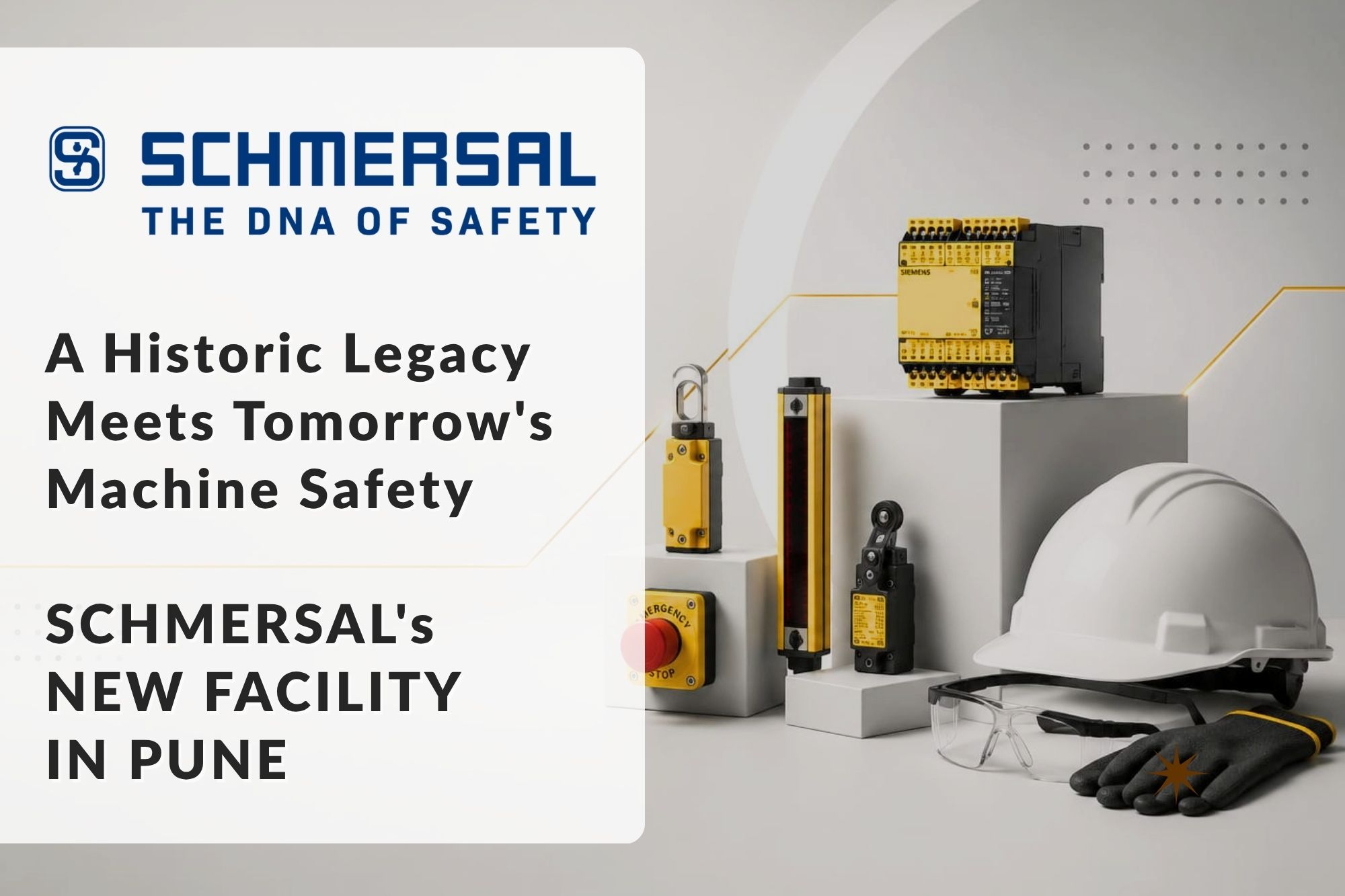
That legacy entered another important chapter on 1 July 2026, when Schmersal India Pvt. Ltd. inaugurated its new corporate office at AP4 Tech Park, Kharadi, Pune. Rather than representing another real estate investment, the approximately 50,000 sq. ft centre has been planned as a strategic destination, bringing application support, digital capabilities, advisory services, customer assistance, specialised training and an interactive Experience Centre under one roof. The initiative comes at a time when machine safety has become a boardroom priority as organisations pursue connected production, artificial intelligence, Internet of Things platforms and autonomous equipment without compromising workforce protection.
Global investment trends underline this transition. The Automation and Control market is currently valued at USD 299.21 billion and is projected to reach USD 632.12 billion by 2034, expanding at a compound annual growth rate of 9.8%. Meanwhile, the Machine Safety market, estimated between USD 6.2 billion and USD 7 billion, is expected to exceed USD 11 billion by 2035 (Source: Fortune Business Insights; MarketsandMarkets). These figures indicate evolving manufacturing priorities where functional diagnostics and advanced monitoring have become strategic business investments alongside digital transformation.
For Schmersal, this investment also coincides with a major corporate milestone. During 2025, the Group completed 80 years since its establishment. Currently, it operates 8 locations across three continents, maintains subsidiaries in 20 countries, collaborates through distributors in over 60 nations and develops about 18,000 machine safety solutions serving customers across multiple application sectors. Its portfolio includes safety switching devices, safety sensors, interlocking devices, safety controllers, software platforms and integrated safety solutions designed to safeguard personnel while supporting increasingly modern manufacturing environments.
Schmersal’s association with India began in 2007, when Schmersal India Pvt. Ltd. (SIPL) was established as a wholly owned subsidiary of the German parent company. Six years later, the organisation expanded its footprint with its Ranjangaon MIDC centre under the Government of India’s Make in India initiative, supplying machine safety solutions to domestic customers while serving global markets through exports. The company is now supported by around 160 employees and a network of 30+ channel partners, catering to automotive, food processing, packaging, machine tools, material handling, pharmaceuticals and several other spaces where functional safety remains fundamental to uninterrupted operations. The inauguration attracted senior leadership representing Schmersal’s global management structure, highlighting the strategic importance of the Indian market within the Group’s protracted business plans. The visiting delegation included Michael Ambros, Managing Director and Member of the Global Board; Uwe Seeger, Director for Asia and the Middle East; Rogerio Baldauf, Managing Director for Brazil; Giovanni Lucido, Managing Director for Italy and Switzerland; Gary Ferguson, Managing Director for the United States; and Anna Dahlem, Global Head of Human Resources. Representatives of the Indo-German Chamber of Commerce (IGCC) and the German Consulate also participated in the ceremony.
The event was led by Ramji Singh, Managing Director of Schmersal India, alongside Directors Henning Carl, Christian Dorr and Uwe Bernd Seeger, symbolising close collaboration between the company’s national leadership and overseas management. The occasion also marked nearly 20 years of Schmersal’s presence in the country, 13 years since the establishment of its Ranjangaon centre and 5 years of the Schmersal Global Competence Center, illustrating the organisation’s steadily expanding contribution across engineering services, software development and machine safety.
This investment represents an important step in advancing industrial safety and automation capabilities. Modern factories increasingly depend upon advanced technologies capable of combining functional safety, digital diagnostics, predictive maintenance and operational efficiency within unified platforms. The widespread adoption of ai, collaborative robotics and connected equipment has elevated personnel safety into a strategic business requirement supporting productivity, regulatory compliance and long-term competitiveness.
These developments place Schmersal India’s expansion at an important point in the evolution of manufacturing. Bringing customer interaction, advisory services, digital capabilities and specialised expertise together within a single location enables closer collaboration while supporting the next generation of advanced manufacturing. India’s engineering economy is entering an evolutionary phase of technological advancement, where investments of this nature will play an increasingly significant role in helping firms adopt globally accepted safety practices while preparing for a future where automated machinery and human expertise work side by side.
For media enquiries, connect at: narendra@synthesisindia.in
Visit: www.synthesisindia.in


