



28th September, 2026
Fire safety has long depended on equipment such as extinguishers, fire hoses, alarms, pumps, emergency exits and trained response teams. These systems continue to form an essential part of protection across factories, warehouses, commercial buildings, public facilities and critical infrastructure. Over the years, however, buildings have become larger, industrial processes have become increasingly complex and emergency situations have become more varied. This has created greater requirements for early detection, fire prevention, suppression, evacuation, rescue, surveillance and emergency communication.
The changing requirements are also visible in the technologies being developed for fire protection and emergency response. Detection systems have progressed beyond conventional alarms, while automatic sprinkler systems, advanced fire pumps, water spray systems, fire doors, smoke detectors and gas detection systems are being used across different types of facilities.Rescue vehicles, aerial ladder platforms, airport fire vehicles, emergency equipment and medical evacuation systems have added further capabilities for response teams. Alongside these established systems, drones, GIS mapping, artificial intelligence, robotics and digital monitoring are opening new possibilities for assessing situations and supporting emergency teams.
Fire safety today involves a wide network of manufacturers, technology companies, engineering firms, consultants, fire services, government authorities, facility managers, architects and professional users. Companies across global markets are developing solutions for buildings, manufacturing facilities, airports, transportation networks, energy installations, hospitals, warehouses and large infrastructure projects. In India, the expansion of construction, manufacturing, logistics, energy and public infrastructure has also increased the requirement for advanced fire protection and emergency response systems.
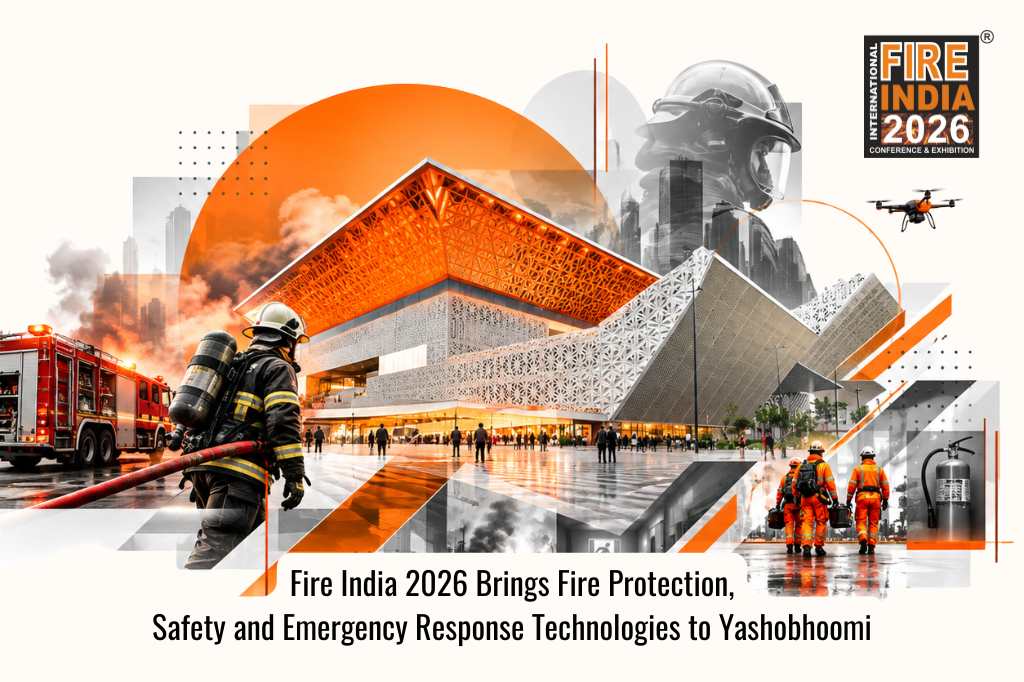
This wider development has created greater importance for professional platforms where equipment manufacturers, technology providers, fire services and users can meet and examine the latest solutions. Fire India 2026, the 20th edition of the fire and safety exhibition and conference, will take place 28 to 30 September 2026 at Yashobhoomi, India International Convention and Expo Centre, Dwarka, New Delhi. The exhibition is presented as South Asia’s largest and most influential fire and safety exhibition and conference, bringing together the fire protection, safety, security and emergency response ecosystem.
The three day event will run between 10:00 am and 6:00 pm, providing a platform for manufacturers, solution providers, government authorities, safety professionals, consultants, technology companies and professional users to present products, examine technologies and exchange technical knowledge. The event is expected to feature over 20 countries, 200+ exhibitors, 400+ delegates and 22,000 plus visitors.
The exhibition presents a wide range of technologies associated with fire protection and emergency response. Firefighting Equipment features extinguishers, fire detection systems, automatic sprinkler systems, fire alarm systems, fire appliances, hoses, hose reels, fire nozzles and fire monitors. These remain essential components of fire protection systems across commercial, industrial and public facilities.
The Active Fire Protection segment features shutters, fire doors, fire pumps, deluge systems and water spray systems. These technologies are used to detect, control or suppress fire conditions and form an important part of protection systems designed around specific building and facility requirements.
Fire Vehicles and Ancillary Equipment feature aerial ladder platforms, airport fire vehicles, firefighting vehicles and rescue vehicles. Such equipment supports fire services in situations where access, height, mobility and emergency response capabilities become essential.
The exhibition also presents Passive Fire Protection, with categories such as gas detectors, fire proof wiring and fittings, monitors, parameter control fire detection systems and smoke detectors. Passive systems have an important role in limiting fire spread and supporting safer evacuation and emergency response. The Surveillance Equipment category features camp and logistic equipment, emergency response equipment, explosive detection, medical and evacuation equipment, NBC detection equipment and test and measurement instruments. The exhibition also presents drone technologies, defence and homeland security, GIS mapping and surveying, technology and information technology companies, aerospace, training and academic institutions, artificial intelligence and robotics.
The breadth of these categories reflects the changing requirements faced by fire services and safety professionals. A modern emergency can involve fire, smoke, hazardous gases, structural conditions, restricted access, large crowds, industrial processes or multiple response agencies. Equipment and systems therefore need to address different stages of an emergency, such as detection, assessment, communication, evacuation, firefighting and rescue.
Companies exhibiting at Fire India 2026 represent this wide range of requirements. The official exhibitor list features manufacturers and solution providers such as fire safety device manufacturers, fire protection system providers, detection technology companies, fire curtain manufacturers, electronics companies, safety product manufacturers and security solution providers.
The conference programme adds a professional knowledge component to the exhibition. Fire research scientists, engineers, technologists, architects, town planners, consultants, fire service officers, health officers, fire and life safety officers, environmental safety professionals, insurers and managers across transport, aviation, ports, shipbuilding, offshore facilities, power plants, fertiliser, refineries, oil and gas, hotels, hospitals and high-rise complexes form part of the wider professional audience addressed by the event.
This broad participation gives Fire India a relevance that extends across several sectors. A manufacturing plant may require fire detection, suppression and emergency response systems suited to its processes. An airport requires vehicles and response equipment. A hospital has requirements linked with evacuation, smoke detection and life safety. A high-rise building needs coordinated fire detection, fire doors, pumps, alarms and evacuation systems. Energy and chemical facilities have their own requirements around hazardous materials, detection and suppression. The technologies displayed at Fire India address many of these different operating conditions.
The event also provides opportunities for professional meetings and business discussions. Through VE Connect, exhibitors and visitors can identify relevant contacts, request meetings and prepare their schedules before reaching the exhibition. The platform allows exhibitors to present their company and product information while visitors can specify the products or services they are seeking and request meetings with relevant exhibitors.
For companies participating at Fire India, the exhibition provides several opportunities to present new products, showcase technologies, meet potential buyers and understand requirements across different markets. The organiser also positions the exhibition as a platform for product launches, business networking and understanding market developments.
One of the notable features of Fire India 2026 is DEMOex, a dedicated live area where exhibitors can present their products and technologies in practical conditions. Instead of relying solely on product specifications or static displays, visitors can see selected technologies operating during scheduled sessions.
DEMOex provides outdoor display space across all three exhibition days, while exhibitors can also reserve specific time slots for their sessions. The format allows companies to present their products before larger visitor groups during selected periods of high foot traffic. The sessions feature both domestic and international technologies.
The live format is particularly relevant for equipment where operation, response time, application and handling are important considerations. Fire protection equipment, emergency response systems and other technologies can be understood more effectively when visitors can see their practical use. DEMOex also operates within designated areas and follows the required permissions and safety procedures, with applicable requirements for drone demonstrations.
The Fire India 2026 Industry Meet & Preview has also provided an opportunity for professional interaction ahead of the main exhibition. Special guests announced for the programme were Mr. Amit Dongre, Chief Fire Officer, Ahmedabad, and Mr. M.P. Mistry, Additional Chief Fire Officer, Ahmedabad. Their presence adds representation of senior fire service professionals to the wider programme surrounding the 20th edition.
The participation of fire service professionals is particularly relevant as equipment development and field requirements need to remain closely connected. Firefighters and emergency teams work under conditions where equipment must function reliably, procedures must be understood and response systems must work together. Manufacturers therefore benefit through direct interaction with professionals who understand practical requirements, while users can examine technologies and discuss their applications with technical representatives.
The evolution of fire safety also includes digital systems. Sensors can provide information about changing conditions within a facility. Connected alarms can transmit alerts quickly. Surveillance systems can provide additional information during an emergency. Drones can support aerial assessment where permitted. GIS systems can assist mapping and site information, while artificial intelligence and robotics are being explored for applications where automated systems can assist people working in difficult or hazardous environments.
These developments are creating new possibilities while established fire protection systems continue to remain essential. Fire extinguishers, pumps, sprinklers, hoses, fire doors, alarms, detectors, protective equipment and firefighting vehicles remain central to emergency preparedness. Digital technologies add another layer of information, monitoring and response capability around these systems.
For India, this evolution has particular relevance as cities expand and facilities become increasingly complex. Manufacturing plants, logistics centres, airports, hospitals, commercial developments, energy facilities, transportation networks and public infrastructure each have different fire and emergency requirements. The need for appropriate equipment is therefore accompanied by requirements for trained personnel, testing, maintenance, emergency planning and regular assessment.
Fire India 2026 provides a single platform where these different requirements can be viewed alongside the technologies being developed to address them. Its exhibition halls will feature equipment for detection, firefighting, active and passive protection, surveillance, rescue, emergency response, security and applications. The conference will bring technical professionals into discussion, while DEMOex will provide an opportunity to see selected technologies operating in practical conditions.
Industrial Safety Review, as media partner for Fire India 2026, will document the exhibition, its participating companies, technologies, demonstrations and professional discussions. The publication will document developments across fire protection, industrial safety, security and emergency response, with attention to products, applications and the people working in these fields.
The future of fire safety will increasingly depend on how effectively different technologies work together. Faster detection, connected monitoring, intelligent systems, rescue equipment, drones, robotics and advanced communication can add new capabilities to established fire protection practices. At the same time, trained fire services and well-designed safety systems will remain central to every response.
Fire India 2026 therefore provides an opportunity to see where this transition is heading. The technologies presented at Yashobhoomi will offer a practical view of how fire protection is evolving, while the conversations between manufacturers, fire services, consultants, authorities and professional users can help shape the systems that will protect buildings, facilities and communities in the future.
For more information, visit: www.fireindia.net
