



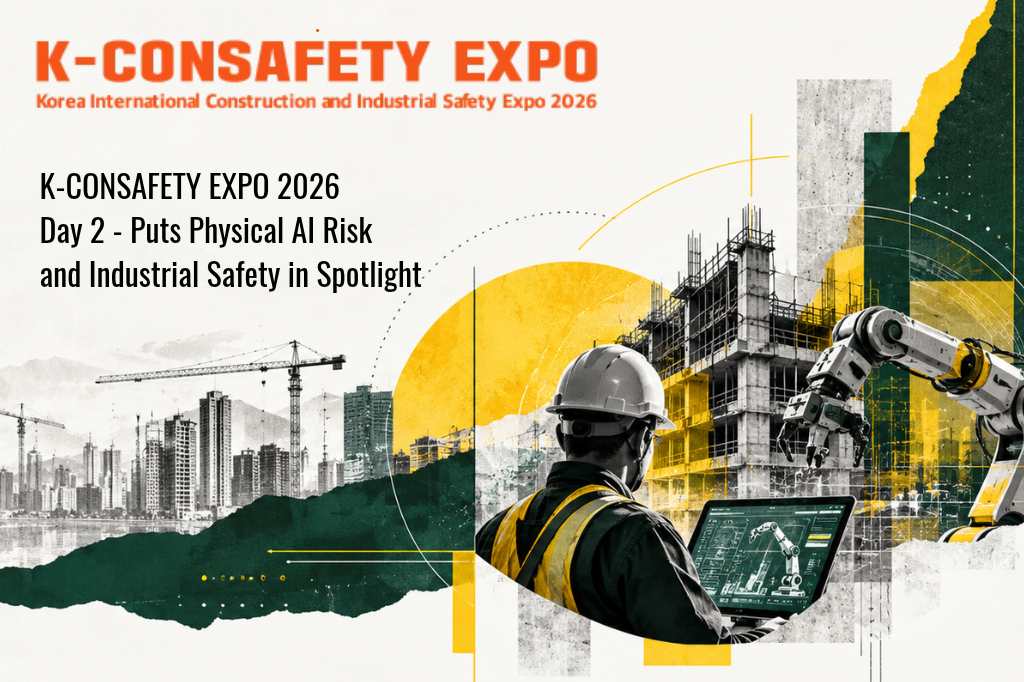
Experts discuss system validation, risk assessment and independent safety controls for intelligent machines operating in complex environments.
MUMBAI, 16 October 2026: When artificial intelligence makes decisions that trigger physical actions, a software error can translate directly into a workplace hazard. As robots, autonomous systems and AI-enabled equipment enter industrial environments, safety management must account for software reliability, cybersecurity vulnerabilities and unpredictable interactions between intelligent systems and their surroundings.
These issues featured prominently in the Day 2 programme of K-CONSAFETY EXPO 2026, held on 15 October at KINTEX Exhibition Center 1 in Goyang, South Korea. The programme covered risk management, smart construction safety and responsible AI deployment, with particular attention to safety requirements for intelligent machines and autonomous systems in the workplace.
Safety Validation for Intelligent Machines
The 34th Future Workplace Safety & Health Forum, organised by Foundation People, addressed risk management for AI enabled machines and autonomous systems during a session held in Room 301 between 2:00 PM and 5:00 PM. Speakers explored emerging applications of intelligent robotics and autonomous technologies across manufacturing, construction and logistics, alongside the safety and security challenges associated with their adoption.
Ha Tae jin, CEO of Virnect, presented technology trends and applications, covering smart glasses, remote collaboration, AI enabled work instructions, vision AI, digital twins and sensor based systems. These technologies can support field personnel, capture operational knowledge and assist in identifying potential hazards through real time analysis.
Kim Hyung seok, CEO of HERS, addressed differences in the adoption of AI enabled autonomous systems across sectors and the need for staged validation. While manufacturing and logistics are approaching early commercial deployment in selected applications, construction remains heavily dependent on demonstrations and field testing. His proposed five stage approach covered preliminary assessment, isolated testing, observational operation, limited field trials and wider deployment, with evidence gathered at each stage before progression.
Cybersecurity Emerges as a Physical Safety Concern
The forum also addressed the relationship between software security and workplace safety. Jeon Yoo seok, a professor in the Department of Computer Science at Korea University, outlined potential threats involving sensor manipulation, attacks on AI models and unauthorised network access.
In AI-enabled robotic and autonomous systems, such vulnerabilities may affect robots, drones, autonomous vehicles and machinery, potentially creating consequences beyond data loss or service disruption. Security testing, software verification and protection across connected systems therefore form an important part of safety management.
Lim Jeong-ho of Safetics addressed the need to assess AI software risks separately from hardware-related risks. His approach called for ongoing verification, restrictions on AI uncertainty and independent safeguards at the equipment level throughout operational use.
The session also covered objective safety evaluation criteria, predefined acceptance and stop conditions, and procedures that allow personnel to intervene during emergencies. Independent safety mechanisms and controlled processes for equipment retrieval, maintenance and restarting were identified as important elements of responsible deployment.
Smart Construction and Specialist Safety Programmes
The broader Day 2 programme covered several technical areas relevant to construction and risk management.
The 2026 Smart Safety Tech Day, organised by the Korea Smart Construction Safety Association, addressed developments in smart safety technology. The Crane Safety Technology Seminar covered safety technologies for cranes and aerial work platforms, while a seminar on future smart construction safety addressed field applications of AI technology.
Other sessions included the Construction Safety Monitoring Association Seminar, a policy seminar on safety manager appointments and career management, and specialist conversations on construction safety, consultancy and workplace health.
Together, these programmes addressed the technical systems, professional expertise and management practices required to improve safety across construction operations. The official visitor guide also listed training programmes and specialist conferences covering disaster prevention, safety management and digital transformation.
Engineering the Next-Gen of Industrial Safety
The Day 2 discussions point towards a future in which safety is built into the design, testing and deployment of intelligent systems. As AI enabled machinery, autonomous equipment and connected monitoring platforms gain ground, engineering teams will need to account for system behaviour, cybersecurity, human intervention and changing site conditions throughout the operational lifecycle.
The future of intelligent automation depends on combining computational power with verifiable safety controls. Validated performance, reliable data, skilled personnel and independent safeguards will determine whether emerging technologies can progress beyond controlled trials into demanding operational environments.
With K CONSAFETY EXPO 2026 concluding on 16 October, attention turns to translating research, engineering advances and field testing into practical systems that anticipate hazards, strengthen operational decisions and protect people across construction, manufacturing and infrastructure.
Intelligent machines, predictive engineering and human expertise can open new horizons in workplace safety. By embedding risk prevention into system design and operational planning, organisations can advance towards workplaces where hazards are identified earlier, interventions are more effective and technological progress delivers measurable protection for people.
