



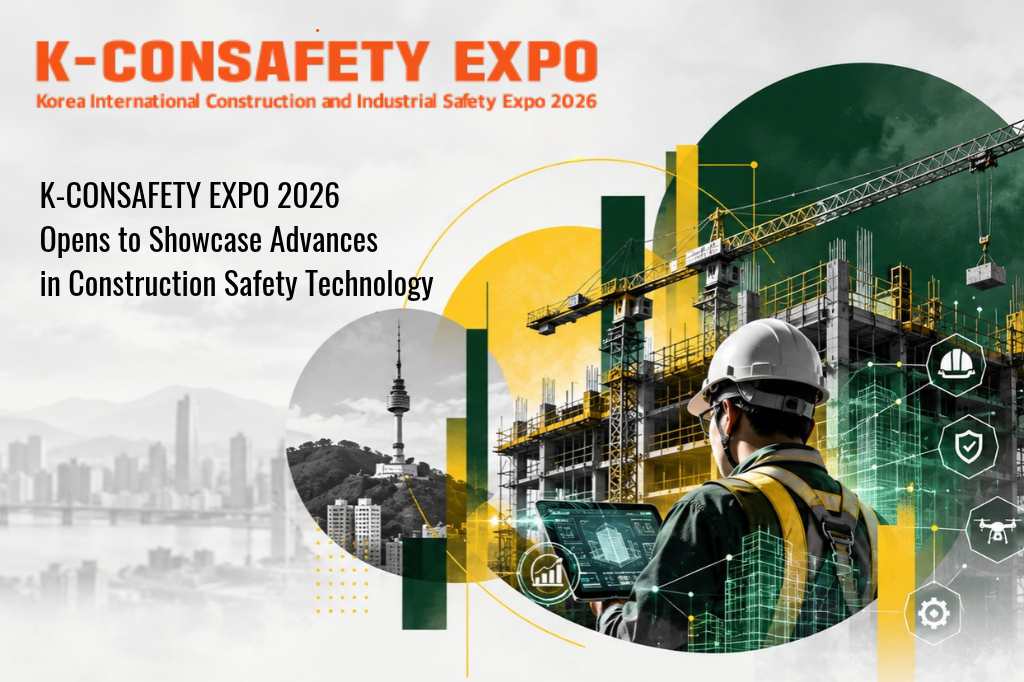
The three-day event connects construction technology providers, safety professionals and public institutions around accident prevention and smarter site operations.
India, 15th October, 2026: The next frontier in construction safety lies in identifying a hazard before it becomes an accident. As artificial intelligence, connected sensors and intelligent monitoring systems enter construction operations, industry professionals are evaluating how engineering and digital technologies can strengthen risk assessment, improve site oversight and prevent serious incidents. Increasingly, safety solutions are being developed to detect unsafe conditions, alert personnel and support timely intervention.
These priorities form a central theme of K-CONSAFETY EXPO 2026, which opened on 14 October at KINTEX Exhibition Center 1 in Goyang, South Korea. Held alongside the Urban Safety Technology Expo, the event brings together construction technologies, sectoral safety solutions and intelligent systems designed to address workplace hazards and strengthen accident prevention. The visitor guide outlines participation by approximately 300 specialised companies and around 30 professional conferences and associated programmes.
AI and Smart Monitoring Drive Exhibition Developments
The opening day presented applications of intelligent technologies in construction site safety. Exhibited solutions included AI-enabled cameras, smart CCTV systems, connected sensors and digital monitoring platforms designed to identify potential hazards and support real time safety management.
Among the demonstrations reported on the show floor were AI cameras mounted behind forklifts, capable of identifying nearby personnel and triggering warnings, alongside mobile intelligent CCTV and integrated construction safety monitoring systems. These applications illustrate the growing use of automated alerts, equipment monitoring and data driven risk assessment in site operations.
The exhibition’s specialised technology zones cover five areas: Construction AI, Underground Safety, Heavy Equipment and Attachments, Advanced Deconstruction, and Advanced Safety. Together, they address risks associated with construction machinery, underground infrastructure, structural dismantling and a wider range of operational activities.
K-Deconstruction Conference Addresses Demolition Safety
A major programme on the opening day was the K-Deconstruction Conference 2026, held from 12:30 PM to 5:00 PM in Conference Room 304 under the theme “Shaping the Future of K-Deconstruction.” The conference addressed safety and technical challenges associated with demolition and structural dismantling, an area of importance amid the redevelopment of ageing buildings and infrastructure.
The programme covered lessons from major demolition accidents, including the Gwangju Hak-dong incident and the Seoul Seosomun Overpass collapse, alongside prevention measures and strengthened safety management for demolition sites. Other subjects included AI based risk assessment, research and development in deconstruction technologies, advanced demolition methods and strategies for developing a more specialised industry.
The conference addresses a significant engineering challenge: structural dismantling requires detailed assessment, appropriate equipment, coordinated site management and effective risk controls. These requirements become particularly important when work takes place around existing structures, congested urban areas and ageing infrastructure.
Technical Sessions Cover Construction and Urban Safety
The opening day’s programme also included certified technology presentations by the Korea Underground Safety Association, a Smart Construction Seminar, AI Safety Management Awards, occupational safety and health awards, and construction safety capacity building sessions. These programmes complemented the exhibition through technical presentations, professional exchange and discussion of emerging safety practices.
Running alongside K-CONSAFETY EXPO, the Urban Safety Technology Expo extends the focus beyond construction sites to public safety, urban infrastructure management, disaster response and technologies designed to protect vulnerable groups. This broader scope connects workplace safety with infrastructure resilience and the prevention of serious public accidents.
Industry Focus Turns Towards Preventive Safety
The developments reported on Day 1 point to a growing convergence of engineering, artificial intelligence and operational safety. Intelligent cameras and connected monitoring systems, along with underground risk assessment and advanced deconstruction methods, address different stages of hazard identification, control and prevention.
The effectiveness of these technologies depends on their performance under actual operating conditions, including the reliability of alerts, the usability of safety data and the readiness of workforces to respond to identified hazards. These considerations place implementation and operational effectiveness alongside technological advancement in construction safety.
Running until 16 October, K CONSAFETY EXPO 2026 provides a platform for professionals to assess these developments across construction, demolition and infrastructure safety, with technical sessions and live demonstrations offering insight into emerging engineering applications.
