


Fourteen companies and institutions receive recognition as the final day accentuates technical compliance, export readiness and specialised safety training.
INDIA, 16 October 2026: A safety solution must meet a demanding engineering test: can it identify a hazard accurately, function under actual site conditions and integrate with established safety procedures? With AI surveillance, connected sensors, smart protective equipment and automated alert systems gaining ground across construction, the evaluation of these technologies increasingly involves technical verification, regulatory compliance and readiness for practical deployment.
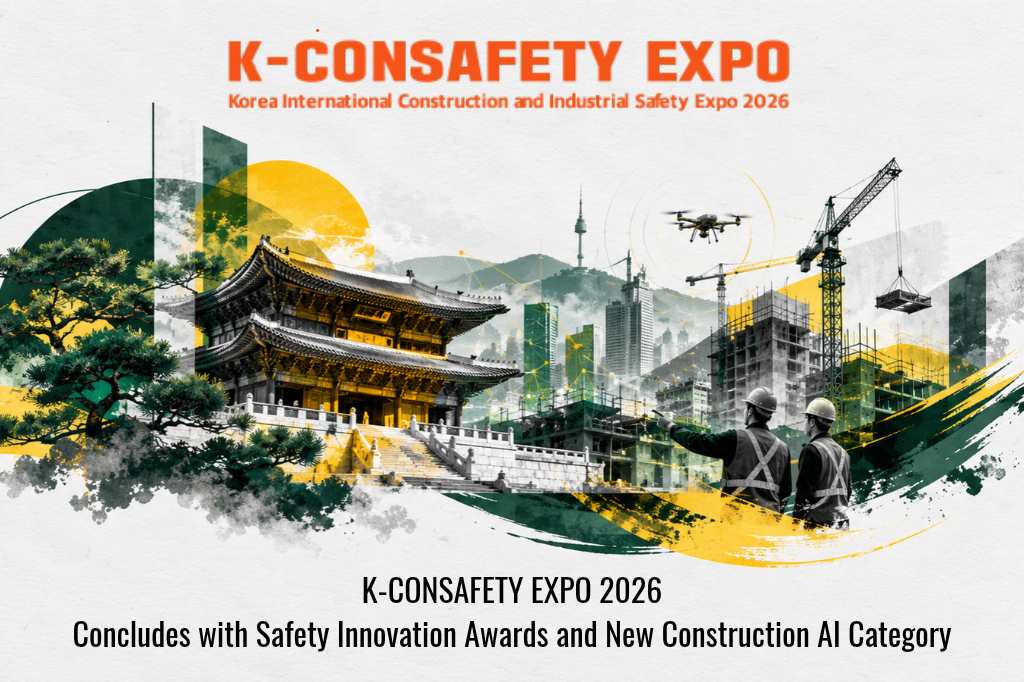
These considerations framed the final day of K-CONSAFETY EXPO 2026, held on 16 October at KINTEX Exhibition Center 1 in Goyang, South Korea. The closing programme featured the K-CONSAFETY Awards, alongside scheduled sessions on overseas market access, export consultation, laboratory safety and professional training. The awards recognised 14 companies and institutions across three categories, including a special Construction AI category introduced for the 2026 edition.
Construction AI Gains a Dedicated Awards Category
The 2026 K-CONSAFETY Awards attracted applications submitted by 54 companies and institutions. A panel of eight specialists representing business, academia and media assessed written submissions and physical products before selecting the recipients. The awards comprised six recipients in Innovation Technology, six in Construction AI, and two in ESG and Shared Growth.
The new Construction AI category recognises the growing role of artificial intelligence in identifying site hazards, monitoring equipment and supporting decisions involving worker safety. Its inclusion also broadens the awards programme beyond conventional protective equipment and mechanical safeguards to include intelligent monitoring and sensor based systems.
In the Innovation Technology category, Meissa received recognition for its digital smart safety monitoring solution. K2 Safety was recognised for its smart airbag vest developed to reduce injury risks associated with falls. Other recipients included Daehan Heavy Industry for its low profile rotating link, JK for the MAXIMUM2 rotating link, Lee San Engineering for its ISAN ESP and ISAN GLS systems, and OneMore Security for its OneMoreEye selective monitoring solution.
The Construction AI category recognised solutions addressing different technical challenges across construction sites.
Sunggeon Engineering received an award for OASIS L, an integrated construction safety monitoring system designed for locations with limited communication connectivity. KCT E&C was recognised for Meerkat, an AIoT sensor based system providing real time risk alerts.
Other recipients included Young Shin D&C for on-device AI mobile CCTV, SAIGE for vision language model based intelligent safety monitoring, HiLocal for AI safety management tailored to workplace requirements, and IT ONE for an integrated solution combining drone-based construction safety and spatial information.
The ESG and Shared Growth category recognised the Construction Safety Monitoring Association for its contribution to professional expertise, public service and serious accident prevention. Gyeonggi Province’s Construction Safety Technology Division also received recognition for its work supporting ESG management practices within the regional construction sector.
Together, the award recipients illustrate the range of engineering approaches being developed to address construction risks, including intelligent surveillance, sensor based alerts, specialised equipment and digital monitoring systems.
Technical Compliance and Overseas Market Access
Safety technology must also satisfy the regulatory and certification requirements applicable to its intended market. Product specifications, testing documentation and conformity requirements can influence procurement decisions, particularly when suppliers seek access to overseas markets.
The final day’s published programme included a briefing titled Technical Barriers to Trade Response Strategies for Overseas Market Entry, scheduled for 10:30 AM to 11:30 AM on Stage C. Organised by the Korea Testing & Certification Industry Association, the session was listed to cover international technical regulations, their implications for exporters, response strategies and available business support programmes.
A separate U.S. Procurement & Export Consulting session was scheduled on Stage D between 10:30 AM and 12:00 PM. Its stated scope included export buyer consultations and a business briefing for companies interested in US procurement opportunities.
These subjects connect technical development with commercial readiness. Manufacturers seeking international contracts must understand the applicable certification requirements, procurement criteria and documentation expected in their target markets. Early consideration of these requirements can help reduce compliance gaps during product introduction and supplier assessment.
Laboratory Safety and Professional Training
The final day’s programme also addressed specialist safety requirements within laboratories and technical workplaces.
The Laboratory Safety Seminar, organised by the Korea Laboratory Safety Experts Association, was scheduled for 2:00 PM to 5:00 PM on Stage D under the title “Laboratory Safety in the AI Era: What Should We Do?” Its inclusion brought laboratory safety into the wider conversation on technology adoption, risk management and the requirements associated with technical systems.
HJ Shipbuilding & Construction also listed a full day of practical training for safety and health managers, scheduled between 9:00 AM and 5:00 PM in Room 205A.
These programmes address an important consideration in safety management: equipment and monitoring systems require trained personnel, suitable procedures and informed decisions. Specialist training supports the practical application of safety requirements, while laboratory safety calls for attention to the specific hazards, equipment and working conditions associated with technical facilities. The published agenda also covered product recognition, regulatory preparedness, professional competency and specialised risk management.
Translating Safety Innovation into Practical Application
The closing day of K-CONSAFETY EXPO 2026 connected three areas that increasingly determine the adoption of safety technology: engineering capability, regulatory readiness and professional expertise.
The K-CONSAFETY Awards recognised a range of solutions, including intelligent monitoring platforms, sensor based warning systems, specialised equipment and connected safety technologies. The compliance and export sessions addressed the requirements associated with international market access, while laboratory safety and professional training covered the human and procedural aspects of implementation.
For construction companies, equipment suppliers and safety professionals, these developments point towards a more integrated approach to risk prevention. AI-based monitoring can help identify hazards, while sensors and automated alerts can support timely intervention. Their practical value depends on appropriate system selection, technical verification, suitable site integration and effective human oversight.
The future of construction safety will be decided by how effectively engineering innovation translates into verified protection on site. Intelligent monitoring, connected equipment, appropriate certification and skilled personnel will all have a role in advancing safer construction practices. The progress recognised at K-CONSAFETY EXPO 2026 provides a useful reference point for evaluating these technologies and their application across construction and infrastructure.
